Broken garage door spring: signs, cost & next steps.
If you heard a bang and the door won't lift, it's almost always a spring. Leave it down. Don't keep pressing the opener. We keep springs on the truck, so most of these are one visit.
4.9 from 111 Google reviews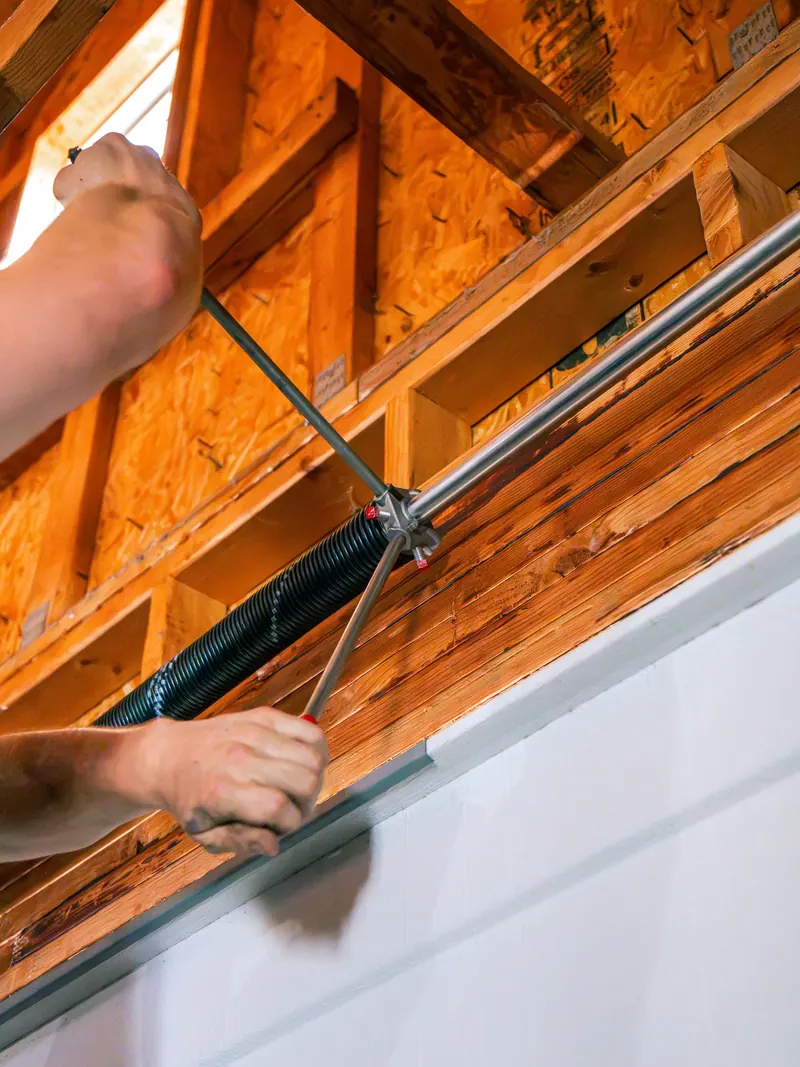
The springs carry the weight of a garage door. A typical double door weighs 150 pounds or more, and the springs counterbalance almost all of it so the opener only has to nudge it. When a spring breaks, that balance vanishes and the door becomes dead weight. That's why a broken spring feels so sudden and so total.
If you're already sure it's the spring, our broken spring replacement carries full-size torsion springs on the truck, so most doors are fixed in one visit, and you hear the price in the garage before any work starts. Keep reading if you want to confirm it first.
The signs a spring has broken
- A loud bang from the garage, often when nobody touched the door. Neighbors sometimes mistake it for a gunshot. That's the torsion spring releasing.
- The door won't open, or lifts a few inches and stops. The opener hits the door's full weight and gives up to protect itself.
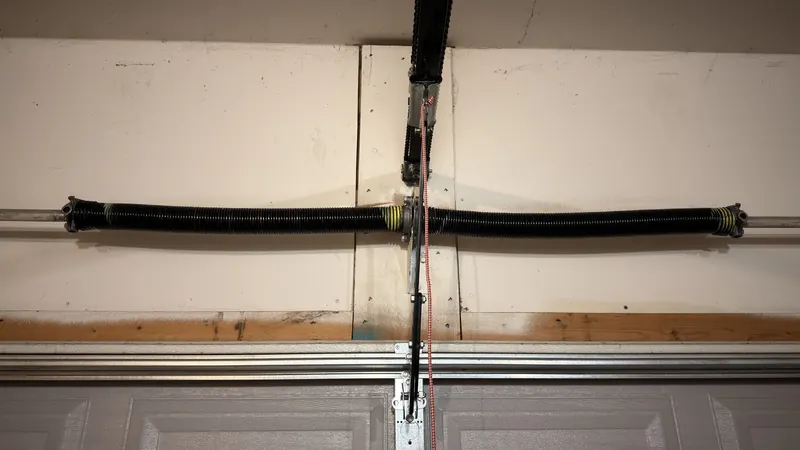
- A two-to-three-inch gap in the spring on the bar above the door.
- The door slams shut faster than normal, or sits crooked. That's common with extension-spring failures.
- The opener motor runs but nothing moves, because the chain is now fighting an uncounterbalanced door.
Torsion vs. extension springs
Two systems do the same job (counterbalancing the door's weight so the opener, and you, can lift it), but they sit in different places and fail differently.
| Torsion spring | Extension spring | |
|---|---|---|
| Where it sits | On a metal bar above the door | Along the horizontal track on each side |
| How it looks broken | A visible 2 to 3 inch gap in the coil | Stretched out, sagging, or hanging loose |
| The tell-tale sign | A loud bang, then the door won't lift | The door slams shut or sits crooked |
| Usually found on | Most modern and heavier doors | Older or lighter single-car doors |
| Replace in pairs? | Yes. Its partner is near the same wear. | Yes. Always replace both sides. |
| Safe to DIY? | No. It holds extreme stored tension. | No. It holds extreme stored tension. |
Why garage door springs break
Springs are rated in cycles, and one cycle is one open and one close. A standard builder-grade spring is rated around 10,000 cycles. A household that opens the door four times a day burns roughly 1,500 cycles a year, so "10,000 cycles" translates to about seven years. Open it more (kids, a side-door garage, a home gym) and that clock runs faster.
In West Michigan there's a second factor: cold. Steel gets more brittle in the cold, and the freeze-thaw swings off Lake Michigan stress a spring that's already near the end of its life. That's why so many springs let go on the first hard freeze. The wear was already there, and the cold delivers the final cycle. We cover the cycle-life math in detail in how long garage door springs last.
What replacement costs
We price spring replacement by the spring's size and how many your door uses, never by the hour or by how stuck you sound. We give you a free estimate before any work starts, so you hear the exact number first. A high-cycle upgrade (springs rated 25,000+ cycles) costs more up front for far longer life.
If your door uses two springs and only one broke, replace both. They're a matched set with the same cycle life, so the survivor is usually weeks from failing too, and a second service call costs more than the second spring.
Repair it or replace the door?
A broken spring on an otherwise sound door is almost always worth repairing, since a new spring is a fraction of a new door's cost. The door itself is only worth replacing if the panels are rotted or badly dented, the door is decades old and you want insulation, or you're chasing a new look. We walk through that decision in repair vs. replace.
Is it the spring or the opener?
This is the one people get wrong, and it's an easy check. Plenty of people search for a broken garage door opener spring, but the opener doesn't have a spring in it. The springs live on the door, either on the bar above it or along the tracks, and the opener is only there to nudge a door the springs are already holding up.
Pull the red release cord while the door is all the way down, then lift the door by hand about a foot. If it's a dead weight and drops the second you let go, it's the spring. If it lifts easily and stays where you put it, the springs are fine and you're looking at an opener problem instead. Never pull the release with the door part-way up.
What a spring sounds like when it snaps
It sounds like a gunshot in the garage. People call us saying something fell off the wall or a car hit the house. A torsion spring is holding a couple hundred pounds of tension, and when the steel lets go it releases all of it at once against the bar it's wound on. If you heard a bang and now the door won't lift, you already know what happened.
Some springs go quietly instead. You come out in the morning, hit the button, the opener strains and the door lifts two inches and stops. It's the same problem, with no bang.
My garage door spring broke on one side
On a two-spring door, one breaking is normal. They were wound the same day, they've run the same number of cycles, and the one still up there is usually weeks behind its partner. We replace both. A second visit for the second spring costs more than the spring does, and in between them the door is running unbalanced, which wears the opener and the cables.
If your door only has one spring, that's normal too on lighter single-car doors. It gets replaced on its own.
People call it a coil, a cable, a rod
It doesn't matter what you call it. If the coil above your door has a gap in it, if there's a cable hanging loose, or if the bar across the top spins freely, describe what you're looking at when you call and we'll know what to bring. We carry full-size torsion and extension springs, cables, drums and rollers on the truck, so most of these are one visit.
What to do right now
Leave the door closed, stop using the opener, and call a technician who carries springs on the truck so it's a one-visit fix. That's exactly how our broken spring replacement works across the Grand Rapids metro: full-size springs in stock, up-front pricing, balanced and cycle-tested before we leave.
We cover the whole metro, including spring replacement in Grand Rapids, Wyoming, Kentwood, Grandville, Jenison and Hudsonville.
Broken spring repair
Door won't go up, or you heard a loud bang in the garage. We put a new pair of springs on, usually the same visit.
Broken springs questions
Can I tell which spring broke?
Look at the bar above the door. A torsion spring breaks into a visible two-to-three-inch gap. If the springs run along the horizontal tracks instead, look for one that's stretched out or hanging. That's a failed extension spring. Either way, the fix is the same: replace it (and its pair).
Is it dangerous to replace a garage door spring myself?
Torsion springs store enough energy to break bones. Every year people are seriously hurt winding springs without the right bars and technique. This is the one repair we tell homeowners to leave alone. Cables and rollers are far more forgiving; springs aren't.
Can I open my garage door with a broken spring to get my car out?
We'd leave it down. With no spring holding it, a double door is 150 pounds or more of dead weight, and it can come down hard if a cable lets go. If your car's stuck inside, call us. After 8pm we still come out for that, and there's no after-hours fee.
What does a broken spring replacement cost near Grand Rapids?
It's set by the spring size and how many your door uses, so we give you a free estimate before any work starts. A standard single torsion spring costs less than a two-spring system or a higher-cycle upgrade. You hear the exact number first.
More garage door guides
Are lifetime garage door springs worth it?
When the higher-cycle upgrade pays for itself, and when a standard spring is plenty.
Balance testHow do I test if my garage door is balanced?
A two-minute test that tells you if the springs are still doing their job, and when to stop and call.
Spring lifeHow long do garage door springs last? It comes down to cycles.
Cycle life explained: what a 10,000-cycle rating means in real years for your door.
Free estimates. No after-hours fee.
4.9 from 111 Google reviewsSame day service. You hear the price before any work begins.